


Skin Education · Acne & Post-Blemish
Why Post-Acne Marks Won't Fade — And What Your Skin Actually Needs
"The breakout is gone. So why does my skin still look the same — dark spots, uneven patches, dull texture — like the blemish never actually left?"
Key Takeaways
- The blemish itself and the mark it leaves behind are two separate things — caused by two separate processes. Clearing the blemish does not automatically clear the mark.
- Post-acne marks are caused by excess melanin deposited during the skin's inflammatory healing response. They are not scars in the structural sense — they are surface-level pigmentation changes that can visibly improve over time.
- Surface buildup — dead skin cells, excess oil, and residue — accumulates on top of post-acne marks and makes them look darker and more defined than they actually are.
- Clearing that surface buildup is the critical first step most people skip. Brightening products applied on top of buildup can't reach the pigmented cells they need to address.
- Picking or squeezing blemishes dramatically worsens the resulting mark — creating deeper inflammation that leads to more pronounced, longer-lasting post-inflammatory pigmentation.
- The Sahara Nila Face Mask helps clear surface buildup and supports a brighter, more even-looking complexion — a key part of a post-blemish routine done consistently.
If you've dealt with acne, you already know the pattern: the blemish clears, and you feel relieved — until you look in the mirror a few days later and realize the dark mark it left behind might stick around for months. Sometimes longer.
The frustrating part is that these marks often look as obvious as the original blemish — sometimes more so. They affect your overall skin tone, make makeup sit unevenly, and can feel impossible to fade no matter how many brightening products you try.
Here's what's actually happening — and why the marks behave so differently from the blemishes that caused them.
Understanding Post-Acne Marks: What They Are and What They Aren't
One of the most important things to understand about post-acne marks is that they are not the same as acne scars — at least not in most cases. The word "scar" suggests a structural change in the skin, like indentation or raised tissue. Post-acne marks — the flat, dark discolorations left after a breakout heals — are something different.
They're called post-inflammatory hyperpigmentation, or PIH. When your skin experiences inflammation — as it does with any blemish — the inflammatory process triggers melanocytes (the pigment-producing cells) to produce excess melanin in the affected area as part of the healing response. Once the blemish resolves, that concentrated pigment remains in the upper skin layers as a visibly darker patch.
The key distinction: PIH is a pigmentation change at the surface level. It does not involve structural damage to the skin. This is important because it means it can, with the right routine and enough time, visibly improve and fade — though it takes consistency and patience.
Why some marks are darker than others:
Several factors determine how dark and long-lasting a post-acne mark becomes:
- Depth of the original inflammation — deeper, more inflamed blemishes trigger a stronger melanin response
- Whether the blemish was picked or squeezed — this dramatically worsens and prolongs the mark
- Natural skin tone — deeper skin tones tend to produce more intense PIH, though all skin types are affected
- UV exposure during healing — sun stimulates additional melanin production, deepening existing marks
- Consistency of a brightening routine — or lack of one
The Two Phases Most People Only Address One Of
Here's where most post-acne skincare routines fall short: they focus entirely on the active blemish phase — the products that help manage breakouts — and treat the post-blemish phase as an afterthought. But once a blemish heals, the skin enters a distinct second phase that requires a different approach entirely.
Phase 1: The active blemish
This is what most people focus on — managing breakouts, reducing inflammation, keeping pores clear. Products like salicylic acid, benzoyl peroxide, and retinoids are common tools here. This phase is about managing the conditions that cause blemishes in the first place.
Phase 2: The post-blemish mark
Once the blemish heals, the skin enters a recovery phase where the excess melanin needs to be gradually moved through cell turnover and cleared from the surface. This phase requires consistent surface clearing — removing dead skin cell buildup that accumulates over the mark and makes it look darker — alongside supporting the skin's natural renewal process. This is the phase most people's routines are missing entirely.
You can have a thorough Phase 1 routine and still be left with persistent dark marks if Phase 2 isn't addressed. The blemishes clear, but the aftermath lingers.
Why Post-Acne Marks Stay Visible So Long
Surface buildup sits on top — and amplifies everything
After a blemish heals, the skin in that area is still in recovery mode. Dead skin cells, excess oil, and any residue from skincare products accumulate on the surface faster than they shed naturally. This buildup layer sits directly on top of the pigmented mark and deepens its visual appearance — making it look darker, more defined, and more textured than the actual underlying pigmentation.
Brightening products can't reach through the barrier
If you apply a brightening serum or spot treatment over a congested surface, the active ingredients are absorbed into the dead skin layer rather than reaching the living pigmented cells below. It's the skincare equivalent of applying a treatment to a surface that isn't actually your skin. This is why so many people use brightening products consistently and feel like nothing is happening — the product is working, but it's not reaching where it needs to go.
UV exposure keeps melanin activated
Every moment of unprotected sun exposure after a blemish heals re-stimulates the already-overactive melanocytes in that area, causing them to produce even more pigment. Post-acne marks can visibly deepen over the summer or after prolonged outdoor time without adequate SPF. Skipping sun protection while trying to fade marks is one of the most counterproductive things you can do.
New blemishes restart the cycle
For people who experience ongoing breakouts, the cycle is almost impossible to outpace: one mark begins to fade while a new blemish forms, heals, and deposits fresh pigment. The result is a continuously uneven complexion that never fully clears — because the second phase is always being reset by the first.
The Sahara Nila Face Mask

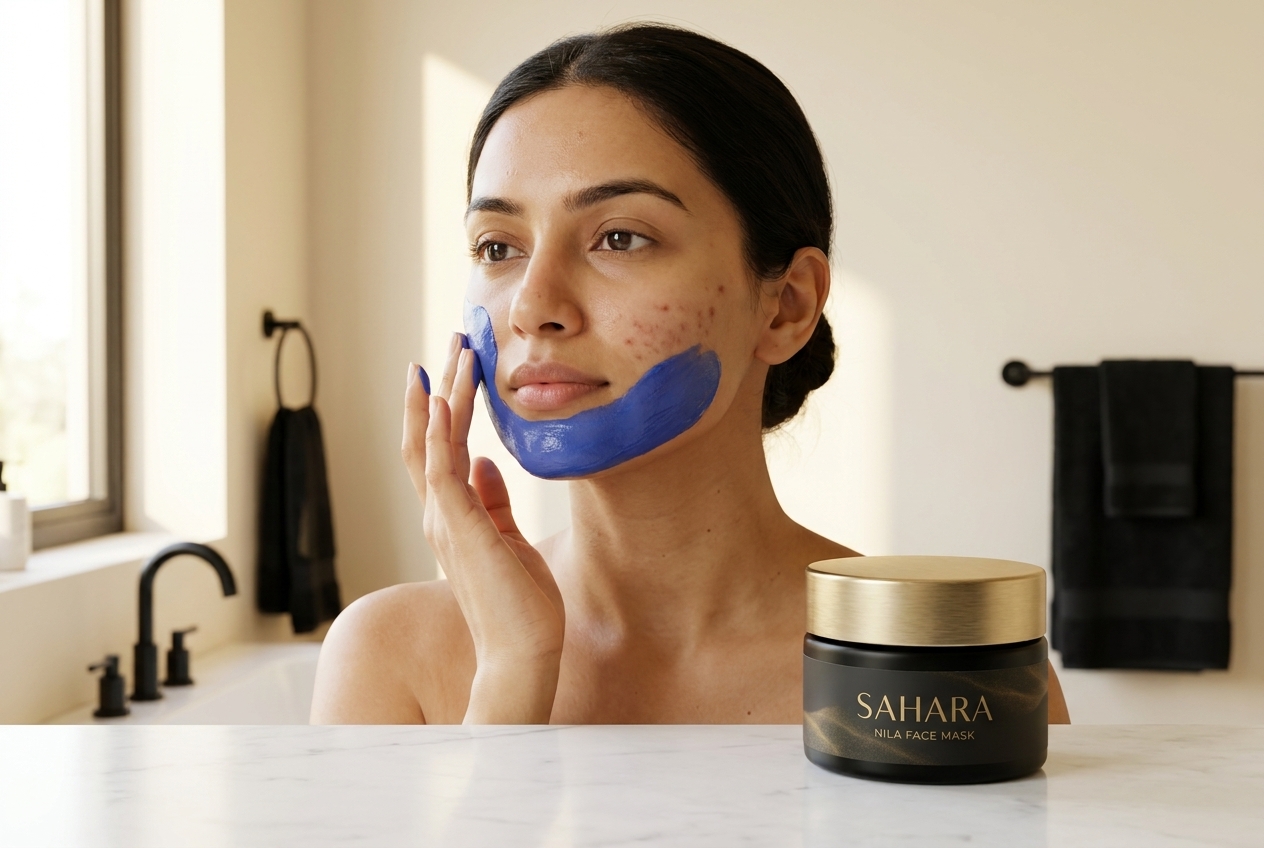
Formulated with Moroccan Blue Nila and kaolin clay, the Nila Face Mask helps clear surface buildup, absorb excess oil, and support a brighter, more even-looking complexion. It's designed as the clearing step your post-blemish routine needs — helping remove what sits on top of post-acne marks so that the skin's natural renewal process can do its work. Use 2–3 times per week.
Shop the Nila Face MaskBuilding a Routine for Post-Acne Marks
A post-blemish routine needs to do three things: clear the surface so treatments can actually reach the skin, support a more even-looking complexion over time, and protect against the UV exposure that deepens and prolongs marks. Here's how to build it:
Cleanse thoroughly — morning and evening
Post-blemish skin produces excess oil as part of the healing process. Thorough double cleansing (especially in the evening to remove SPF, makeup, and the day's buildup) ensures the surface is clean before any treatment or mask is applied. Residue left overnight adds to the congestion that makes marks look worse.
Apply the Nila Face Mask 2–3x per week
On clean, dry skin, apply an even layer of the Nila Face Mask and leave for 10–15 minutes. The kaolin clay and Moroccan Blue Nila formula helps lift away dead skin cell buildup and absorb excess oil — clearing the surface layer so the skin's own renewal process can bring fresher, more even-looking skin to the surface. Start with 2x per week and adjust based on how your skin responds.
Moisturize after every mask session
Clearer skin is also more vulnerable skin — once the buildup layer is removed, the underlying skin needs hydration support to maintain its barrier. Apply a non-comedogenic moisturizer immediately after rinsing. Supporting your skin barrier consistently reduces the low-grade inflammation that contributes to ongoing melanin overproduction.
SPF every single morning — without exception
If there is one non-negotiable step for fading post-acne marks, this is it. Daily UV exposure — even through windows, even on cloudy days — directly stimulates the overactive melanocytes sitting in those marks. Without SPF, even a well-executed post-blemish routine can feel like it's going nowhere. Apply SPF 30 or higher every morning as the last step before leaving the house.
What to Realistically Expect
Results vary. This content is informational and does not constitute medical advice. If you are experiencing active acne, consult a dermatologist. Patch test before use and avoid applying to active, inflamed blemishes.
Common Mistakes That Keep Post-Acne Marks Around Longer
What most people get wrong:
Frequently Asked Questions
What's the difference between post-acne marks and acne scars?
Post-acne marks (post-inflammatory hyperpigmentation) are flat, dark discolorations caused by excess melanin deposited during the skin's healing response — they are a surface-level pigmentation change. Acne scars refer to structural changes in the skin, such as indentations (atrophic scars) or raised tissue (hypertrophic scars). PIH can visibly improve with a consistent brightening and clearing routine. Structural scarring is different and may require professional treatment. If you are unsure which type you have, consult a dermatologist.
Can the Nila Face Mask help with post-acne marks?
The Nila Face Mask is formulated to help clear surface buildup and support a more even, brighter-looking complexion — which makes it a useful part of a post-blemish routine. It helps remove the dead skin layer that sits on top of post-acne marks and amplifies their appearance, supporting the skin's natural renewal process. It is not a clinical acne treatment and does not treat or remove acne scars. Results vary.
Can I use the Nila Face Mask on active blemishes?
We recommend applying the mask to areas of the face where blemishes have healed and left marks, rather than directly on active, inflamed blemishes. The mask is designed for clearing surface buildup and supporting even-looking skin tone — not for treating active acne. If you have active blemishes, spot-apply around them rather than over them, and consult a dermatologist for active acne management.
How long does it take for post-acne marks to visibly improve?
It varies — but a realistic timeframe for most people is 8–12 weeks of consistent routine use. More recent, lighter marks can start to look less defined within 4–6 weeks. Older, darker marks that have been present for months may take longer. Consistent SPF use is the biggest variable — without it, improvement is significantly slower regardless of what else is in the routine.
Is the Nila Face Mask safe for acne-prone skin?
The Nila Face Mask is formulated with kaolin clay, which is widely used in skincare for oily and acne-prone skin types. Patch test before use — apply a small amount to your inner forearm and wait 24 hours. If your skin is actively breaking out or feels reactive, start with a shorter application time and once-weekly frequency. Do not apply to broken, actively inflamed, or freshly picked skin.
Do I still need a retinoid or vitamin C if I'm using the Nila Face Mask?
The Nila Face Mask is a surface-clearing step, not a replacement for other brightening actives. Think of it as the preparation step that makes your other products work better — by removing the buildup barrier so actives like vitamin C or niacinamide actually reach the skin. If you use brightening actives and feel they aren't performing, adding a consistent clearing routine (like the face mask) before applying them may improve how well they work.
Final Thoughts
Post-acne marks are one of the most persistent and emotionally frustrating skin concerns — because unlike the blemish itself, the mark sticks around long after the problem is resolved. But they are not permanent. They are surface-level pigmentation changes, and they do respond to the right approach.
The missing piece for most people isn't a stronger product — it's a clearer surface. Clear the buildup first. Let your brightening routine actually reach the skin. Protect it every morning. Give it time. The Nila Face Mask is built to be that first step — the one that makes everything else in your post-blemish routine actually work.
Start consistent. Stay patient. Your skin is doing its best to heal — give it the support it needs to get there.
Brighten · Smooth · Protect